Underground Water Tank Cleaning
Underground Water Tank Cleaning Sydney, Blue Mountains, Central Coast , NSW Wide
Out of sight should never mean out of mind. Underground water tanks are one of the most overlooked assets on any property and because you cannot see inside them, contamination, sediment buildup, and structural issues can go undetected for years.
At Transform Water, we specialise in professional underground water tank cleaning across New South Wales. Whether you are in Sydney, the Blue Mountains, Central Coast, Hunter Valley, Wollongong, or regional NSW, our confined space-certified team has the equipment and training to clean, inspect, and service your underground tank safely and thoroughly.
Why Underground Tanks Need Specialist Cleaning
Underground tanks present a unique set of challenges that standard above-ground tank cleaning simply cannot address. Because they are buried, they are:
- Harder to inspect — contamination and sediment build up undetected over months and years.
- More vulnerable to groundwater intrusion — cracks in the tank wall or base can allow contaminated groundwater, soil seepage, and root ingress to enter the tank.
- Subject to greater sediment accumulation — debris washes in through inlet points and settles at the bottom, creating a thick layer of sludge that degrades water quality and damages pump systems.
- Confined spaces — entry requires specific confined space training, equipment, and safety protocols under Australian WHS regulations. Not every contractor is qualified or equipped to do this safely.
- Out of sight — without regular professional inspection, problems go unnoticed until they cause expensive failures or health risks.
If your underground tank has not been cleaned in the last 2 to 3 years, it is overdue

Risks of an Unclean Underground Water Tank
The water in an underground tank can look perfectly clear while still being unsafe. Common risks in neglected underground tanks include:

Bacterial contamination
E. coli, coliform bacteria, giardia, and salmonella can establish in tanks where organic matter has accumulated.

Sediment and sludge damage
the thick layer of sediment that builds up on the tank floor acts like an abrasive on your pump system, causing motor burnout and voiding manufacturer warranties.

Algae and biofilm growth
even in underground tanks with limited light, biofilm layers can form on interior walls and create conditions for harmful microbial growth.

Septic and wastewater contamination
for underground tanks near septic systems or wastewater infrastructure, leachate can seep into the tank through cracks, introducing a serious contamination risk.

Structural deterioration
undetected cracks, joint failures, and corrosion left untreated lead to costly structural repairs or full tank replacement.

Council compliance issues
many NSW councils require underground tanks that form part of a stormwater management system to be maintained to a documented schedule. Failure to comply can result in enforcement
Our Underground Water Tank Cleaning Process
We follow a structured, safety-first process on every underground tank job.
Step 1 — Site Assessment and Confined Space Safety Check
1
Before any team member enters the tank, we conduct a full confined space risk assessment in line with Australian WHS regulations. This includes atmospheric testing (checking for oxygen levels, toxic gases, and flammable vapours), reviewing the tank access point, and confirming our safety equipment and emergency procedures are in place. No shortcuts — every underground tank entry is treated as a confined space entry regardless of tank size.
Step 2 — Tank Inspection
2
Once the tank is confirmed safe to enter, our technician conducts a full internal inspection. We check for:
- Sediment depth and composition
Cracks, joint failures, and signs of groundwater intrusion - Biofilm or algae growth on walls and surfaces
- Inlet and outlet condition
- Pump and filter connections
- Lid and access point integrity to confirm pests cannot enter
We document our findings and will discuss any structural concerns with you before proceeding.
Step 3 — Sediment and Sludge Removal
3
Using purpose-built vacuum and pump equipment, we remove all accumulated sediment, sludge, organic matter, and debris from the tank floor and walls. All waste is collected and disposed of responsibly — it is not discharged into your garden, stormwater system, or drainage lines.
Step 4 — High-Pressure Internal Cleaning
4
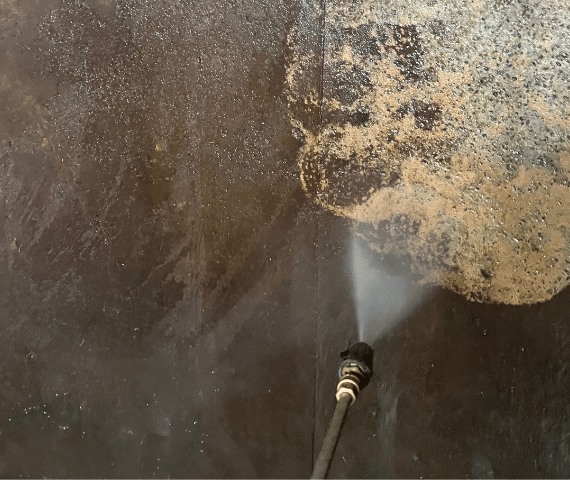
After the bulk of the sediment is removed, we high-pressure clean the interior walls, floor, and any accessible surfaces to remove residual biofilm, algae, and staining. This step ensures the tank is genuinely clean, not just emptied.
Step 5 — Disinfection
5
We apply a safe, food-grade disinfectant approved for potable water tank use to kill any remaining bacteria, fungi, and microbial contamination. This is safe for your water supply and complies with Australian Drinking Water Guidelines.
Step 6 — Filter, Pump, and Inlet Check
6
We inspect and clean the inlet strainer, first-flush diverter (where fitted), pump connections, and any filtration components as part of every underground tank clean. If we identify any issues with filters or pumps, we will advise you on repair or replacement options.
Step 7 — Water Quality Test and Completion Report
7
Once cleaning is complete, we carry out a water quality test to confirm pH levels and that the water is safe for use. You receive a written completion report detailing the work performed, test results, and any observations about the tank’s condition. This documentatnbvion is useful for property records and for demonstrating compliance with council stormwater management requirements.
Commercial and Residential Underground Tank Cleaning
Residential Properties
If your home has an underground rainwater tank — under the driveway, beneath the lawn, or installed during a new build — regular cleaning is essential. Sediment accumulates quietly over time and the impact on your pump system and water quality can be significant. We work around your schedule and cause minimal disruption to your property.
Acreage and Rural Properties
Rural properties across NSW often rely on underground tanks as their primary or secondary water supply. When tank water is your only source, water quality is not optional. We regularly service properties across the Blue Mountains, Hunter Valley, Illawarra, Southern Highlands, and regional NSW — and we understand the specific challenges of rural access and high-capacity tanks.
Commercial, Stormwater, and Council Compliance
Many NSW councils require properties with underground stormwater tanks to maintain a documented maintenance schedule as part of their stormwater management plan. Transform Water can help you meet these requirements with professional cleaning, written reports, and ongoing maintenance plans tailored to your site. We service commercial properties, schools, apartment complexes, industrial sites, and body corporates across Greater Sydney and NSW.

What Types of Underground Tanks Do We Clean?
We clean all types of underground water tanks across Sydney and NSW, including:

Poly underground tanks
common in new residential builds, typically 5,000L to 30,000L, installed under driveways or lawns.

Concrete underground tanks
found on older properties, acreages, and commercial sites. Concrete tanks are prone to cracking and sediment accumulation and require thorough inspection on every clean.

Fibreglass underground tanks
Often used in stormwater harvesting systems. We inspect for liner delamination and joint integrity.

Commercial and industrial underground storage tanks
Larger capacity tanks on commercial properties, schools, apartment blocks, and industrial sites requiring documented maintenance schedules.

Stormwater detention and retention tanks
Underground tanks installed as part of a council-approved stormwater management system. These require regular cleaning and maintenance to remain compliant and functional.

Fire water storage tanks
Underground fire suppression tanks require clean, uncontaminated water to function correctly. We clean and inspect these to ensure your fire system is ready when it matters.
Why Choose Transform Water for Underground Tank Cleaning?
- Confined space certified: Every underground tank entry is performed by trained, qualified technicians following Australian WHS confined space protocols.
- Purpose-built equipment: We use specialised vacuum and pump equipment designed for underground tank access, not repurposed above-ground gear.
- Full-service approach: We do not just remove sludge. We inspect, clean, disinfect, test, and report, so you know exactly what condition your tank is in.
- Water quality testing included: Every clean includes a water quality test. You receive results in your completion report.
- Council compliance documentation: We provide the written records you need to demonstrate compliance with stormwater management plan requirements.
- Statewide coverage: We service all of NSW from Sydney suburbs to regional and rural properties across the state.
- Transparent pricing: No hidden fees. We assess your tank and give you a clear quote before any work begins.

Areas We Service for Underground Water Tank Cleaning in NSW
Transform Water services underground water tanks across all of NSW, including:
- Greater Sydney: All suburbs across Western Sydney, South West Sydney, Inner West, Eastern Suburbs, North Shore, Northern Beaches, Sutherland Shire, and the Hills District.
- Blue Mountains and Hawkesbury: Katoomba, Lithgow, Penrith, Windsor, Richmond, Springwood, and surrounding areas.
- Central Coast: Gosford, Wyong, Terrigal, The Entrance, Tuggerah, Lake Macquarie, and surrounds.
- Hunter Valley and Newcastle: Newcastle, Maitland, Cessnock, Singleton, Muswellbrook, Dungog, and regional Hunter.
- Wollongong and Illawarra: Wollongong, Shellharbour, Kiama, Dapto, Figtree, and the broader Illawarra region.
- Southern Highlands and Goulburn: Bowral, Mittagong, Moss Vale, Picton, Goulburn, and Wollondilly.
- South Coast NSW: Nowra, Ulladulla, Batemans Bay, Moruya, and surrounds.
- Central West and Regional NSW: We service regional NSW properties
Can’t see your area? Call us on 1800 702 156 and we will let you know if we can get to you.
Get a Quote for Underground Water Tank Cleaning
Ready to book your underground water tank clean? Contact Transform Water today.
Call 1800 702 156 or use the quote form on this page. We service all of NSW including Sydney, the Blue Mountains, Central Coast, Hunter Valley, Wollongong, the Southern Highlands, South Coast, and regional areas statewide.

Frequently Asked Questions
Every 2 to 3 years is the standard recommendation for residential tanks. For stormwater tanks that form part of a council-approved stormwater management system, your maintenance schedule may be specified in your stormwater management plan. Commercial tanks should be cleaned at least annually. If your tank has never been cleaned, or you are unsure when it was last serviced, book an inspection now.
Only with the correct training, equipment, and safety protocols. Underground tanks are classified as confined spaces under Australian WHS legislation. Transform Water’s team are confined space trained and certified. All underground tank entries are conducted with atmospheric testing, standby personnel, and emergency procedures in place.
In many cases, yes. Our equipment allows us to remove sediment and sludge from the tank floor without fully emptying the tank, which minimises water loss and disruption to your supply. We will advise you on the best approach based on your tank’s condition during the initial assessment.
Yes. We regularly clean tanks installed under driveways, slabs, and lawns. As long as there is an access hatch, our equipment can reach the interior. If the access hatch is inadequate or damaged, we can advise on access solutions.
Yes. We provide a written completion report with details of the work performed, water test results, and any observations about the tank’s condition. This can be used to demonstrate compliance with council stormwater management plan requirements.