
Why Underground Tanks Are Not Just a Harder Version of the Same Job
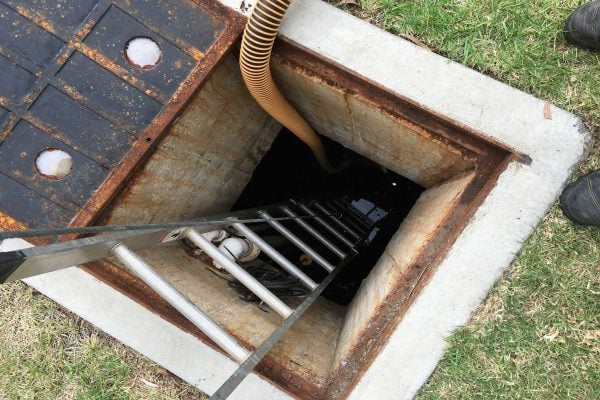
An underground tank is a confined space under the Work Health and Safety Act. That means entry is legally restricted to workers who are specifically trained and certified for confined-space work. A cleaner who is not confined-space trained cannot legally enter an underground tank — and if they do, both they and the principal contractor are in breach of the WHS Act.
Why Underground Tanks Accumulate Sediment Faster
1. Soil temperature stability keeps biological activity going year-round
Above-ground tanks experience significant temperature variation between summer and winter, which suppresses biological activity during cooler months. Underground tanks stay at a relatively stable temperature, which supports consistent low-level biological activity in the water year-round.
2. Greater hydrostatic pressure on the water column
In deeper underground tanks, the water at the base is under more pressure. This doesn’t cause sediment to accumulate faster, but it does compact sludge at the base more thoroughly, making extraction harder.
3. Access constraints mean cleaning is deferred longer
Underground tanks are out of sight and typically out of mind. Because homeowners can’t easily inspect them, cleaning tends to be deferred until a water quality problem prompts action. By that point, sediment layers are more substantial.
NSW Confined Space Regulations: Who Is Legally Allowed to Enter
Under the Work Health and Safety Regulation 2017 (NSW), before a confined-space entry can take place:
- A permit must be issued by a competent person (confined-space entry permit)
- The atmosphere inside the tank must be tested for oxygen levels, flammable gases, and toxic substances
- A standby person must be stationed outside the tank during all confined-space work
- Entry and rescue equipment must be available at the access point
When getting quotes, ask specifically: “Are your technicians confined-space certified, and will you issue a confined-space entry permit before the work begins?”
Equipment Differences: What’s Used Below Ground
| Equipment | Above-Ground Use | Underground Use |
|---|---|---|
| High-pressure washer | Standard residential unit | Confined-space rated, lower exhaust risk |
| Pump for water extraction | Submersible or inline | Submersible pump capable of reaching tank depth |
| Sludge extraction | Vacuum unit with standard hose | Extended-reach sludge vacuum, camera confirmation |
| Lighting | Natural or portable | Confined-space rated, explosion-proof lighting |
| Ventilation | Not typically required | Forced-air ventilation before and during entry |
Signs an Underground Tank Is Due for a Clean
- Reduced pump flow or pressure. When the outlet is partially blocked by sludge build-up, the pump works harder and flow rate drops.
- Water discolouration at the tap. Brown, yellow, or murky water — especially after a refill event that disturbs the sediment layer.
- Earthy or musty smell in tap water. Biological activity in accumulated sludge produces this odour.
- Long period since last clean. If you don’t know when the tank was last cleaned or if it’s been more than 3–5 years, schedule an inspection.
The Underground Cleaning Process: Step by Step
- Camera survey through the access hatch. An inspection camera confirms sediment levels and identifies any structural concerns.
- Atmosphere testing. A gas and oxygen test of the internal atmosphere before any entry. Entry does not proceed until the atmosphere is confirmed safe.
- Pump-down using a submersible pump. Water is extracted down to the minimum level required for effective cleaning.
- Sludge vacuum extraction. An extended-reach sludge vacuum removes the compacted sludge from the base.
- High-pressure wash. Interior walls, base, and lid are high-pressure washed using confined-space rated equipment.
- Disinfection treatment (where required). A food-grade disinfectant applied at the correct concentration with the correct contact time.
- Post-clean camera verification. A second camera survey confirms the base and walls are clean and identifies any structural findings.
- Written report. Documents atmosphere test results, the confined-space permit, cleaning process, and structural observations.
Frequently Asked Questions
Why does underground tank cleaning require confined-space certification?
An underground tank is a confined space under the Work Health and Safety Act. Entry is legally restricted to workers specifically trained and certified for confined-space work. A cleaner who is not confined-space trained cannot legally enter an underground tank — if they do, both they and the principal contractor are in breach of the WHS Act.
Why do underground tanks accumulate sediment faster than above-ground tanks?
Three factors contribute: soil temperature stability keeps biological activity going year-round (unlike above-ground tanks that experience suppression in cooler months), greater hydrostatic pressure at depth compacts sludge more thoroughly making extraction harder, and access constraints mean cleaning is deferred longer, allowing sediment layers to build more substantially.
What are the signs that my underground water tank needs cleaning?
Reduced pump flow or pressure, water discolouration at the tap (especially after a refill event that disturbs the sediment layer), an earthy or musty smell in tap water, and a long period since the last clean — if you don’t know when it was last cleaned or it’s been more than 3–5 years, schedule an inspection.
What should I ask a tank cleaner before booking an underground clean?
Ask specifically: “Are your technicians confined-space certified, and will you issue a confined-space entry permit before the work begins?” These are legal requirements, not optional precautions. If the answer is hesitant, that’s a red flag.
Does my underground tank access hatch need to be a certain size for cleaning?
Yes. For a confined-space entry to be safe, the access hatch needs to be large enough to allow a technician wearing full PPE (including a harness where required) to enter and exit. If your access hatch is less than 600mm in diameter or square, confirm with your tank technician before booking — hatch upgrades are possible and are sometimes required before cleaning can proceed.
Related Articles
What Happens to Water Quality After a Tank Clean? How to Get Your Water Back to Safe Drinking Standard
Your water isn't immediately safe after a tank clean. Follow this flush, disinfect and test...
Underground vs. Above-Ground Rainwater Tank: Which Is Right for Your NSW Property?
Underground or above-ground rainwater tank? Full cost, maintenance, council approval and suitability comparison for NSW...
When Should You Service Your Rainwater Tank Filtration System? Signs, Intervals, and What Gets Checked
Rainwater tank filtration systems need servicing every 6–12 months. Learn the signs it's overdue, what...
