

The Right Tank for Your Property Is Not Always the One You Imagine
Most people, when they think of a rainwater tank, picture the classic round poly tank sitting beside the house. Smaller blocks, heritage properties, strata developments, and properties with limited side access often find above-ground installation impossible or impractical. Underground tanks solve the space problem but introduce a different set of considerations.
Side-by-Side Comparison
| Factor | Above-Ground (Poly/Concrete) | Underground (Poly/Concrete) |
|---|---|---|
| Typical installed cost | $2,000–$6,000 | $5,000–$15,000+ |
| Installation time | Half a day to 1 day | 1–3 days (excavation required) |
| Space requirement | Requires yard space | Uses no above-ground space |
| Water temperature | Subject to seasonal variation | Stable temperature year-round |
| UV protection | Risk of UV degradation (poly) | Complete UV protection |
| Maintenance access | Easy — visual inspection, easy hatch access | Requires confined-space protocols |
| Cleaning complexity | Standard above-ground clean | Confined-space rated clean required |
| Pump requirement | Gravity-fed possible in some setups | Always requires a pump |
| Lifespan (poly) | 20–30 years with UV protection | 30–50 years (no UV exposure) |
Underground Tank Types: Concrete Cistern vs. Poly Underground
Concrete cistern
In-situ concrete cisterns can be built to virtually any custom size and shape, making them useful for properties with irregular underground spaces or very large storage requirements (100,000L+). They require an interior waterproofing membrane compliant with AS/NZS 4020 for drinking water contact. Without a compliant membrane, lime leaching from the concrete affects water quality.
Underground polyethylene tanks
Purpose-built underground poly tanks are made from high-density polyethylene with a ribbed exterior structure designed to resist the lateral pressure of surrounding soil. Installation is faster than an in-situ concrete tank. They typically range from 2,000L to 30,000L.
Water Temperature and Quality Benefits of Underground Storage
Underground storage provides a naturally stable temperature environment — typically 16–20°C year-round. This has two meaningful effects:
- Reduced algae risk. Algae grows significantly more aggressively in warm water. An underground tank that stays below 20°C is inherently less hospitable to algae than an above-ground poly tank that reaches 35–40°C internally on a hot Sydney summer day.
- No UV-related degradation. Underground poly tanks experience neither UV radiation nor thermal cycling — which explains their longer expected lifespan compared to above-ground equivalents.
Access and Long-Term Maintenance: What Underground Actually Means
An above-ground tank allows you to see the exterior, open the lid and do a quick visual check, check the first flush diverter, and monitor for any obvious issues at any time. An underground tank requires confined-space rated technicians for any internal inspection or cleaning, an access hatch that meets confined-space entry sizing requirements, and a cleaning service that costs more and requires more lead time to book.
Pump Requirements: Does an Underground Tank Always Need a Pump?
Yes. Every connection point in a house — toilet cisterns, laundry taps, garden taps — is above ground level. An underground tank without a pump delivers nothing. The pump must be sized for the depth of the tank (a deeper tank requires a pump with a higher static lift rating) and the volume of usage.
Best Use Cases: Matching Tank Type to Property
| Property Type | Recommended Option | Reason |
|---|---|---|
| Small suburban block (under 400sqm) | Underground poly | No above-ground space; visual amenity |
| Standard suburban block with side access | Above-ground round poly | Cost-effective, easy maintenance |
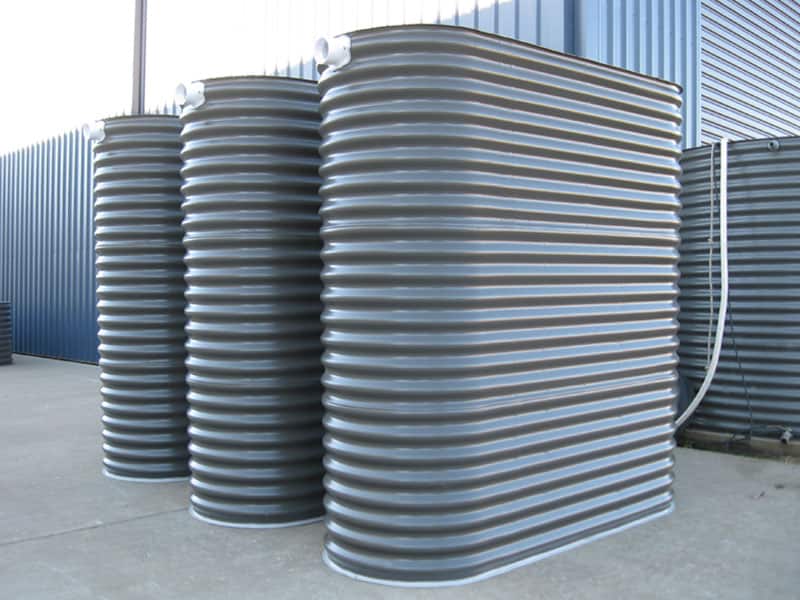
| Narrow block or slim side access | Above-ground slimline poly | Profile designed for tight spaces |
| Acreage or rural property | Above-ground round poly or concrete | Large capacity; easy access; gravity options |
| Strata or townhouse complex | Underground concrete cistern | Shared facility; large capacity; no visual impact |
| Heritage conservation area | Underground poly or concrete | Often required by council |
Frequently Asked Questions
What is the cost difference between underground and above-ground water tanks in NSW?
Above-ground tanks typically cost $2,000–$6,000 installed. Underground tanks cost $5,000–$15,000+ due to excavation, machinery, and backfill requirements. Underground poly installation budgets from $4,000 upwards for underground poly, more for in-situ concrete.
Does an underground water tank always need a pump?
Yes. Every connection point in a house — toilet cisterns, laundry taps, garden taps — is above ground level. An underground tank without a pump delivers nothing. The pump must be sized for the depth of the tank (a deeper tank requires a pump with a higher static lift rating) and the volume of usage.
Why do underground water tanks last longer than above-ground tanks?
UV radiation and thermal cycling are the two main causes of polyethylene degradation in above-ground tanks. Underground poly tanks experience neither — which explains their longer expected lifespan of 30–50 years compared to 20–30 years for above-ground equivalents with UV protection.
Do I need council approval for an underground water tank in NSW?
Underground installation involves excavation, soil disposal, structural works, and in some cases proximity to stormwater or sewer pipes, gas lines, or electrical conduits. Most NSW councils require either a Complying Development Certificate or a full DA for underground tank installation. The requirements vary by LGA — check with your council’s development desk or ask your installer to confirm the approval pathway for your address.
Why does an underground tank have less algae risk than an above-ground tank?
Algae grows significantly more aggressively in warm water. An underground tank that stays at 16–20°C year-round is inherently less hospitable to algae than an above-ground poly tank that reaches 35–40°C internally on a hot Sydney summer day. The stable underground temperature suppresses the conditions algae needs to thrive.
Related Articles
What Happens to Water Quality After a Tank Clean? How to Get Your Water Back to Safe Drinking Standard
Your water isn't immediately safe after a tank clean. Follow this flush, disinfect and test...
When Should You Service Your Rainwater Tank Filtration System? Signs, Intervals, and What Gets Checked
Rainwater tank filtration systems need servicing every 6–12 months. Learn the signs it's overdue, what...

Can a Cracked Poly Water Tank Be Repaired? What’s Fixable, What Isn’t, and What It Costs
Most cracks in polyethylene water tanks can be repaired by plastic welding. Find out what's...
